In this proposal for a cinematographic installation it is inevitable to go directly to the Marcel Duchamp reference and at the end of the “ready made”, use an everyday object to create an artistic work, without hiding the origin of the object.
In particular, Out of Field, enters into what Duchamp calls “reciprocal ready made”, given that the object changes its function by extracting it from its usual use, by separating it from everyday use and placing it in another space if its connotation changes. and they fall “deterritorialized.”
This film installation presents several layers: a physical layer, which is the ceramic sink, to which is added a second layer, the video (loop image) of the sinks, which allows the object to shine with the light of This is an image in color, which surrounds us and creates a third layer, where that hybrid between the physical and the projected emerges. The fourth cover is the projection of the Fuera de Campo video, which is displayed on the wall in front of the sculptural object.
The visual is complemented by an acoustic layer (soundscape), in which the spaced and intermittent sounds of opening and closing the sink faucet, the flow of water through the siphon, transport us to the “everyday” relationship, subject – object. , which, in this case, refers to a situation “idealized” by families in settlements that lack public services.
The use of the washing machine, that “useful object” that we believe is in every home in Colombia; It goes from being seen as a useful object for everyday use, to an object that offers us a critical and reflective perspective on a problem of inequality.
In the installation, when using the concept of “found object” there is a double meaning, given that, in the end, the washed hand is an object that appears “outside the field”, without leaving the usual place, and at the same time, when placed in a space just for the sake of it, will refer us to one of my objectives, which is to highlight how this valuable object is not part of the home of the families that live in settlements in Colombia.
¿Cómo la ausencia de maquinaria obsoleta y la presencia de películas encontradas replantean nuestra experiencia de la imagen en movimiento? Cuando un archivo no es solo un registro del pasado, sino un recipiente que da forma a la imaginación contemporánea, la ausencia misma se convierte en material.
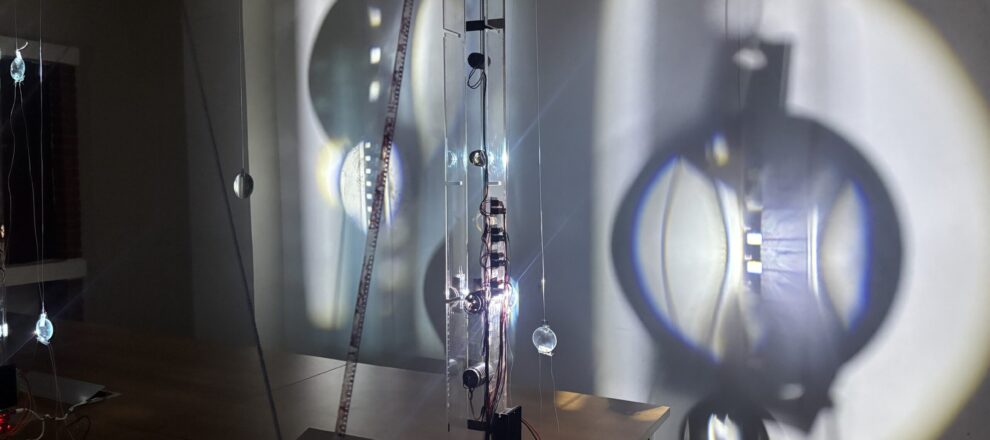
Esta instalación de película analógica revisita la proyección como un acto espacial. Utilizando un proyector artesanal, abraza la entropía —el desenfoque, la distorsión y la difusión de la luz— la imagen como algo entre la luz y la lente. La obra cuestiona las formas de ver una película y explora la proyección como performance, donde la luz, la lente y la memoria se entrelazan.
Nacido del descubrimiento fortuito de películas de 8 mm sin medios para verlas, el proyecto busca nuevas prácticas para los medios obsoletos. Al hacerlo, renueva la fisicidad táctil e impredecible de la película analógica, un medio que se resiste al borrado al exigir continuamente presencia, tacto y reinvención.
Este 2026 PROYECTOR celebra su 19ª edición, reafirmando prácticas, propuestas, obras y discursos que no responden a modas sino a una necesidad. El festival se consolida como uno de los primeros espacios dedicados a la imagen en movimiento, y tras casi 20 años de trayectoria mantiene su espíritu y urgencia por el videoarte. Si bien el festival impregna y hace suya desde 2008 la ciudad de Madrid con el Recorrido OFF, ampliando el programa a través de la implicación de galerías y museos, también se abre a una red internacional activa en colaboración con festivales como InShadows (por), Loops.Expanded, PLAY (arg), URUGUAY (uru) y VIDEOBARDO (arg).
Desde el 9 hasta el 20 de septiembre, PROYECTOR activa Madrid a través de más de 30 sedes, un año más con la participación de artistas de 30 países diferentes y una presencia mayoritariamente femenina, ocupando desde instituciones, espacios independientes hasta estudios de artistas. Articulando así un recorrido con más 100 obras entre las cuales hay performance, cine expandido, videoarte e instalaciones site specific. Cada una de estas, en diálogo con los contextos que las acogen. Por ello, desde PROYECTOR no proponemos una experiencia de carácter uniforme sino que se trabaja con la diversidad de formatos, procedencias y posiciones, en medio de un momento de homogeneización y saturación visual, siendo un espacio importante desde donde observar, expresar y pensar el presente.
Durante el festival, el acceso es gratuito, pues PROYECTOR se compromete en el desarrollo del espacio cultural accesible, transmitiendo además todas las actividades en streaming para ampliar su alcance más allá del ámbito local.
Paralelamente, VERTICAL<25 continúa con el apoyo y fomento a los creadores más jóvenes en formato vertical ofreciendo residencia de producción, exhibición y acompañamiento anual.