10.09.2026. 21.30h
Artists: Maddi Barber, Mira Klug y Tosca Schift
“Nobody colonises innocently, and nobody colonises with impunity either.” (1)
Aimé Césaire reminds us that colonisation is not merely the occupation of territory. It is a form of appropriation that transforms what it encounters into available material: bodies, cultures, resources, knowledge and territories. For Césaire, colonisation is also a process of objectification.
Perhaps from here we can look at the earth as an archive. Not an ordered, closed archive, but an accumulation of times, traces and remains. That which has been displaced, extracted, concealed or transformed remains, in some way, inscribed in the place itself. The earth holds a history that does not always coincide with the one we have chosen to tell.
Esta es una plaza is, in itself, a story of territorial transformation. A plot of land abandoned for more than thirty years was reclaimed in 2008 by residents of Lavapiés and transformed into a garden, vegetable plot, playground, meeting place and space for creation. Land ceased to be an available void and became a shared place. A space maintained and cared for collectively.
The square thus proposes a particular way of relating to space: not based on its usefulness or its capacity to produce, but on care and shared use. The earth not as a resource, but as a place for life. It is precisely around these different ways of relating to the land that the three works in this exhibition meet, presenting different landscapes crossed by processes of displacement, extraction and transformation.
Walter Benjamin wrote that “there is no document of civilisation which is not at the same time a document of barbarism” (2). History can also be read through what remains at its margins: traces, remnants, objects and ruins. Progress leaves documents behind. It also leaves wounds.
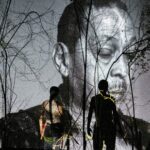
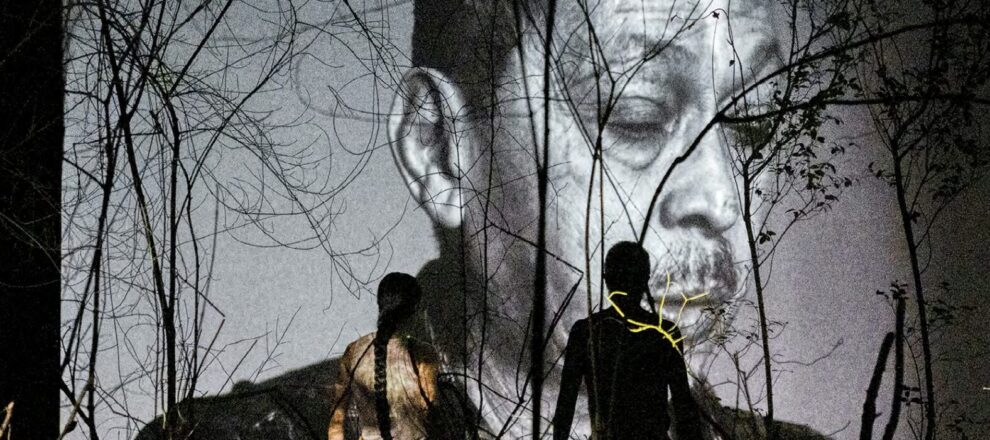
In It’s too cold for the spirits to live here, Dutch artist Tosca Schift begins with a family memory shaped by colonial displacement. A family leaves Indonesia in 1958 and travels to the Netherlands. During the journey, the spirits that had formed part of their lives disappear. The ship then becomes a space suspended between times and territories, while the family archive reopens what had remained stored away for years.
The search for the spirits is also a search for memory. The film extends beyond the screen: rootless trees stand between the projector and the image, casting their shadows across it. A radio searches for signals in the present. The body, the knife, the cannon blast and the felling of trees make colonial violence appear as a physical presence. The past is not over: it remains among us.
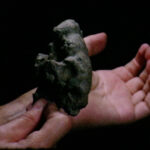
Spanish artist Maddi Barber approaches memory through archaeology. Harria & Poltsa (Stone & Bag) observes the archaeological site of the San Adrián tunnel and the processes through which what remains buried is found, extracted, studied and displaced.
Archaeology thus appears as a practice of displacement. To remove something from the earth is to change its place, its context and also its meaning. The screen participates in this same paradox. It is a mobile structure that holds images and which, like archaeological objects, can change context. Appearance also implies displacement.
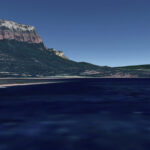
In Swallowed Matter, Austrian artist Mira Klug brings this relationship between territory and exploitation into the present. A dried-up reservoir appears as the ruin of an earlier energy model and, at the same time, as the landscape onto which a new form of extraction is projected: that of the infrastructures sustaining artificial intelligence.
Technology presents itself as progress, as a promise of efficiency, knowledge and the future, while concealing what it requires in order to exist. Data centres consume water, energy and territory; they depend on matter and resources to produce an image of the immaterial. Artificial intelligence seems to inhabit a space without land, bodies or landscape, yet its operation depends precisely on them.
Klug does not show the data centre. She shows the landscape that allows us to imagine its existence. The dried-up reservoir thus appears both as a ruin and as a warning. The technological future does not arrive from outside the territory: it feeds upon it. Perhaps the real problem lies precisely in what the word progress manages to conceal.
Colonialism, archaeology and techno-colonialism move through different times and contexts, but the three works share a concern with what remains after a place has been intervened upon. Against the logic that turns landscape into resource, they propose pausing before its traces: listening to what persists, attending to what has disappeared, and allowing matter to reveal what history does not always manage to tell.
At Esta es una plaza, an abandoned territory becomes a space of collective care. For one night, images arrive in this place, trees interfere with the projections, structures occupy the ground and bodies move through the images. Video becomes another layer within urban life.
Perhaps looking at the earth as an archive also means learning to relate to it differently. As something that stores, returns, resists and also looks back at us.
(1) Césaire, Aimé (2006). Discurso sobre el colonialismo. Madrid: Akal. Translation by Juanmari Madariaga, Beñat Baltza Álvarez and Mara Viveros Vigoya.
(2) Benjamin, Walter (2021). “Sobre el concepto de historia”, in Tesis sobre el concepto de historia y otros ensayos sobre historia y política. Madrid: Alianza Editorial.
Text: Joana Groba