Ésta es una Plaza!

Esta es una Plaza began as a project in late 2008, driven by the initiative of a group of citizens—mostly residents of the Lavapiés neighborhood—interested in making use of a vacant lot located at 24 Doctor Fourquet Street, which had remained unused for over thirty years.

The project gained momentum following the workshop Interventions in Empty Urban Spaces, organized by the Urbanación collective in collaboration with La Casa Encendida and coordinated by Esterni from Milan. The specific action carried out during the workshop was to propose the transformation of the lot into a green space for alternative leisure and collective enjoyment. This proposal responded to the neighborhood’s needs, identified through a study conducted at the time with local residents. During the brief workshop period, participants intervened in the lot by clearing out accumulated garbage and rubble and outlining some of the areas envisioned in the site's future development.

Thanks to the success of the initiative, the original core group—comprising the workshop’s participants, mostly architects, artists, and biologists—along with other residents who had joined the process and were motivated to give the project greater reach and longevity, began the necessary procedures to obtain the official cession of the land from the Madrid City Council, the site’s owner. The first step was to establish themselves as a Cultural Association under the project’s existing name: Esta es una Plaza. Their goal was to turn this one-time action into a larger initiative, inspired by a desire to experiment with and develop a citizen-led, self-managed process in the spirit of similar initiatives that have emerged in cities around the world in recent decades. One key reference here is the Main Verte program.

The challenge of working together, voluntarily and in a coordinated way, to consolidate a collaborative space open to the public is today a reality. Through a series of interventions and activities over the years, the space has been transformed from a barren lot into a peaceful, green area that offers enjoyment for both children and adults—providing an alternative form of recreation and a space for social gathering and coexistence. The project developed at Esta es una Plaza represents a more human and inclusive way of inhabiting the city, while also being environmentally conscious. It is a living and educational space that has gained recognition and interest from academic and cultural sectors, and that sees itself as a daily event built through self-reflection, participation, and consensus.

1. Esta es una Plaza is the name of the lot where the project is located, the community that has formed around it, and the association that runs it.

2. Main Verte is a program created by the Paris City Council to support the creation of community gardens through formal agreements between participants and the municipality.

3. This movement emerged in the 1960s in New York, thanks to the inclusive and participatory policies of the city’s Department of Parks and Recreation, and reached its peak during the severe fiscal crisis of the 1970s.

4. These are publicly owned gardens open to anyone who wants to learn gardening.

THE EARTH AS ARCHIVE: MEMORY, COLONIALISM AND PROGRESS

10.09.2026. 21.30h

Artists: Maddi Barber, Mira Klug y Tosca Schift

“Nobody colonises innocently, and nobody colonises with impunity either.” (1)

Aimé Césaire reminds us that colonisation is not merely the occupation of territory. It is a form of appropriation that transforms what it encounters into available material: bodies, cultures, resources, knowledge and territories. For Césaire, colonisation is also a process of objectification.

Perhaps from here we can look at the earth as an archive. Not an ordered, closed archive, but an accumulation of times, traces and remains. That which has been displaced, extracted, concealed or transformed remains, in some way, inscribed in the place itself. The earth holds a history that does not always coincide with the one we have chosen to tell.

Esta es una plaza is, in itself, a story of territorial transformation. A plot of land abandoned for more than thirty years was reclaimed in 2008 by residents of Lavapiés and transformed into a garden, vegetable plot, playground, meeting place and space for creation. Land ceased to be an available void and became a shared place. A space maintained and cared for collectively.

The square thus proposes a particular way of relating to space: not based on its usefulness or its capacity to produce, but on care and shared use. The earth not as a resource, but as a place for life. It is precisely around these different ways of relating to the land that the three works in this exhibition meet, presenting different landscapes crossed by processes of displacement, extraction and transformation.

Walter Benjamin wrote that “there is no document of civilisation which is not at the same time a document of barbarism” (2). History can also be read through what remains at its margins: traces, remnants, objects and ruins. Progress leaves documents behind. It also leaves wounds.

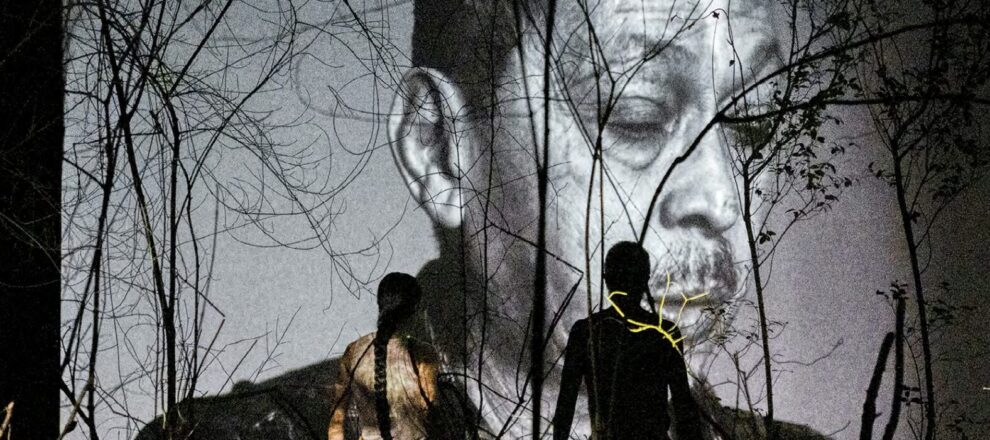
In It’s too cold for the spirits to live here, Dutch artist Tosca Schift begins with a family memory shaped by colonial displacement. A family leaves Indonesia in 1958 and travels to the Netherlands. During the journey, the spirits that had formed part of their lives disappear. The ship then becomes a space suspended between times and territories, while the family archive reopens what had remained stored away for years.

The search for the spirits is also a search for memory. The film extends beyond the screen: rootless trees stand between the projector and the image, casting their shadows across it. A radio searches for signals in the present. The body, the knife, the cannon blast and the felling of trees make colonial violence appear as a physical presence. The past is not over: it remains among us.

Spanish artist Maddi Barber approaches memory through archaeology. Harria & Poltsa (Stone & Bag) observes the archaeological site of the San Adrián tunnel and the processes through which what remains buried is found, extracted, studied and displaced.

Archaeology thus appears as a practice of displacement. To remove something from the earth is to change its place, its context and also its meaning. The screen participates in this same paradox. It is a mobile structure that holds images and which, like archaeological objects, can change context. Appearance also implies displacement.

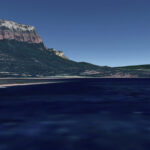
In Swallowed Matter, Austrian artist Mira Klug brings this relationship between territory and exploitation into the present. A dried-up reservoir appears as the ruin of an earlier energy model and, at the same time, as the landscape onto which a new form of extraction is projected: that of the infrastructures sustaining artificial intelligence.

Technology presents itself as progress, as a promise of efficiency, knowledge and the future, while concealing what it requires in order to exist. Data centres consume water, energy and territory; they depend on matter and resources to produce an image of the immaterial. Artificial intelligence seems to inhabit a space without land, bodies or landscape, yet its operation depends precisely on them.

Klug does not show the data centre. She shows the landscape that allows us to imagine its existence. The dried-up reservoir thus appears both as a ruin and as a warning. The technological future does not arrive from outside the territory: it feeds upon it. Perhaps the real problem lies precisely in what the word progress manages to conceal.

Colonialism, archaeology and techno-colonialism move through different times and contexts, but the three works share a concern with what remains after a place has been intervened upon. Against the logic that turns landscape into resource, they propose pausing before its traces: listening to what persists, attending to what has disappeared, and allowing matter to reveal what history does not always manage to tell.

At Esta es una plaza, an abandoned territory becomes a space of collective care. For one night, images arrive in this place, trees interfere with the projections, structures occupy the ground and bodies move through the images. Video becomes another layer within urban life.

Perhaps looking at the earth as an archive also means learning to relate to it differently. As something that stores, returns, resists and also looks back at us.

(1) Césaire, Aimé (2006). Discurso sobre el colonialismo. Madrid: Akal. Translation by Juanmari Madariaga, Beñat Baltza Álvarez and Mara Viveros Vigoya.

(2) Benjamin, Walter (2021). “Sobre el concepto de historia”, in Tesis sobre el concepto de historia y otros ensayos sobre historia y política. Madrid: Alianza Editorial.

Text: Joana Groba
FESTIVAL 2026

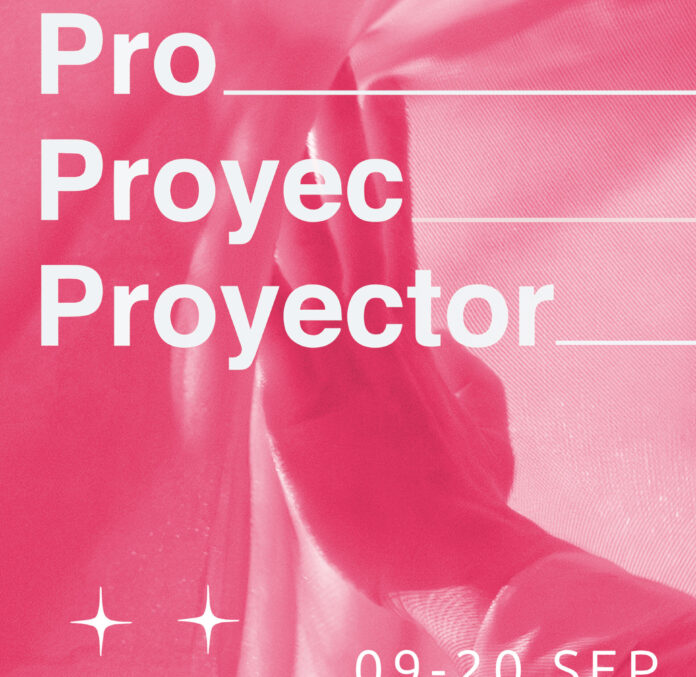
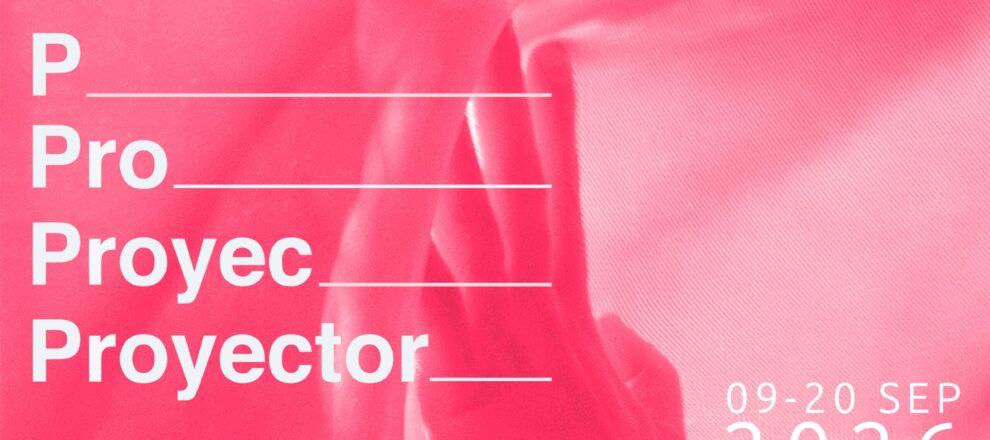
Este 2026 PROYECTOR celebra su 19ª edición, reafirmando prácticas, propuestas, obras y discursos que no responden a modas sino a una necesidad. El festival se consolida como uno de los primeros espacios dedicados a la imagen en movimiento, y tras casi 20 años de trayectoria mantiene su espíritu y urgencia por el videoarte. Si bien el festival impregna y hace suya desde 2008 la ciudad de Madrid con el Recorrido OFF, ampliando el programa a través de la implicación de galerías y museos, también se abre a una red internacional activa en colaboración con festivales como InShadows (por), Loops.Expanded, PLAY (arg), URUGUAY (uru) y VIDEOBARDO (arg).

Desde el 9 hasta el 20 de septiembre, PROYECTOR activa Madrid a través de más de 30 sedes, un año más con la participación de artistas de 30 países diferentes y una presencia mayoritariamente femenina, ocupando desde instituciones, espacios independientes hasta estudios de artistas. Articulando así un recorrido con más 100 obras entre las cuales hay performance, cine expandido, videoarte e instalaciones site specific. Cada una de estas, en diálogo con los contextos que las acogen. Por ello, desde PROYECTOR no proponemos una experiencia de carácter uniforme sino que se trabaja con la diversidad de formatos, procedencias y posiciones, en medio de un momento de homogeneización y saturación visual, siendo un espacio importante desde donde observar, expresar y pensar el presente.

Las obras seleccionadas mediante convocatoria abierta por un jurado internacional son reconocidas gracias a los Premios Hertzog Da Silva con una dotación global de 20.000€. El jurado ha estado compuesto por Sergio Cabrera, Lide Billelabeitia, Gabriel Castaño y Mauricio Carmona.

Durante el festival, el acceso es gratuito, pues PROYECTOR se compromete en el desarrollo del espacio cultural accesible, transmitiendo además todas las actividades en streaming para ampliar su alcance más allá del ámbito local.

Paralelamente, VERTICAL<25 continúa con el apoyo y fomento a los creadores más jóvenes en formato vertical ofreciendo residencia de producción, exhibición y acompañamiento anual.

Mario Gutiérrez Cru, director
Winifel Castillo, coordinadora


ARTISTAS

Finalistas: Alan Kwan (chi), Andrea Novoa (chi), Bojan Fajfric (srb), Go‑Eun Im (kor), Hanchen Zhang (chn), HeeSue Kwon (kor), Max Hilsamer (ale), Ilaria Di Carlo (ita), Julian Palacz (aus), Karel van Laere (bel), Fani Boudouroglou (grc), Maddi Barber (esp), Mira Klug (aut), Nils Benedikt Fischer (deu), Paola Guzmán Figueroa (col/fin), Sahand Sarhaddi (irn), Stein Henningsen (nor), Stuti Bansal (ind), Taylor Alaina Liebenstein Smith (eeuu/fr), Tianhui Wu (chn) y Tosca Schift (hol)

Invitados: Antone Berastegui Rodríguez (bel), Ángel Biyanueba (esp), Arturo Franco y Tono Mejuto (esp), Bruno Delgado Ramo (esp), Chus García-Fraile (esp), Dave Mawer (eeuu), Emiliano Reyes (méx), Favio Redondo (esp), Gözde Mimiko Türkkan (tur), Malo Lacroix & Mutaqaa (fra), Raffaella Rosset (bra), Ramón González Echeverría (esp), Roberto López Flores (méx), Shinri Tosif (ira/aus), Yon Bengoechea (esp), Yuan Goang Ming (tw) y Ж (bra).

Vertical <25 2025: Petra Montoro (esp)
Vertical <25 2026: Cristina Souto Pita, Zeltia Pérez Barrientos y Natalia Rodríguez Amido, June Martín, Laura Nogales, Carmela Aranzadi Montolío, Isidora Lalut Toledo, Jose Manuel Frias y Carlos Enrique Pasaron, Ana Gómez del Pulgar Rodríguez, Bruno Aramburu, Sofía Sánchez Menéndez, Elisa García Hernández, Elisa Bianca Poiana y Diego Iglesias Muerza

Colección INELCOM (Anthony McCall (ing), Anna Barriball (ing), Antoni Muntadas (esp), Artur Heras (esp), Bruce Conner (eeuu), Caló y Queimadela (por), Candice Breitz (sud), Ceal Floyer (pak), Claire Harvey (ing), Eugenio Ampudia (esp), Francis Alÿs (bel), Gabriel Abrantes (bra), Gary Hill (eeuu), Giorgio Andreotta Caló (ita), Gusmão / Paiva (por), Hiraki Sawa (jap), Ignasi Aballí (esp), Jack Goldstein (can), Joan Jonas (eeuu), Jorge Macchi y Edgardo Rudnitzky (arg), José Val del Omar (esp), Laure Prouvost (fra), Lewis Klahr (eeuu), Liliane Lijn (eeuu), Lúa Coderch (esp), Marijke van Warmerdam (hol), Micol Assaël (ita), Miroslaw Balka (pol), Ólafur Eliasson (din), Pavel Büchler (che), Pieter Geenen (bel), Raha Raissnia (ira), Rosa Barba (ita), Steve McQueen (ing), Tom Friedman (eeuu) y Willie Doherty (irl).

PROYECTOR OFF: Archivo Arkhé, Atelier Cromático, Espacio Peseta x Patio Collective, Estudio Ben Roberts, Galería Elba Benítez, La Gran Gallery, Estudio Le Batiment, The Ryder Projects Gallery y Museo Centro de Arte Reina Sofía MNCARS (ciclo cine y nuevos medios)

FESTIVALES INTERNACIONALES
LOOPS.Expanded: Rui Soares Costa & André Gonçalves (por)
INSHADOWS (por) – Zacharie Ellia, Daniel Gurton, Kati Kallio y Márcio Simões
PLAY (arg) – Violeta Pons, Maysoon Abdelghany y Noemí Fleitas
Comisariado de Ernestina Pereyra Gallo Adentro hay un río. Diálogo con ocho videos” (uru): Ana Aristimuño, Cecilia Mattos, Elisa Ríos, Julia Castagno, Karina Flores, Martha Castillo, Nair Gramajo, Valentina Cardellino.
Comisariado de Gabriela Rosselló Caics (uru) “UY, UY, UY.”– Artistas: Anaclara Talento Acosta, Federico Arnaud, María Fernanda Piñeirúa, Mayra Da Silva, Javier Abreu, Jorge Fierro, Matilde Campodónico, Shonna dela Tahonna y Teresa Puppo
VIDEOBARDO (arg) – Ignacio Mendía (arg), Anna Guasch (esp), Myriam Rey (fra), Tullio Restrepo (col), Nige Goldsmiths (uk), André Vallias (bra), Josh Weissbach (usa), Tom Konyves (can), Jakob Kirchheim (ale), Javier Robledo (arg), Rodolfo Mata (méx) y Ntouro Louiza (gre).


CALENDARIO*

* puede sufrir cambios


No event specified.

PROYECTOR 2026

09.09.2026 20.09.2026

PROYECTOR 2025

10.09.2025 21.09.2025

PROYECTOR 2024

11.09.2024 22.09.2024

PROYECTOR 2022

07.09.2022 18.09.2022

PROYECTOR 2021

08.09.2021 19.09.2021

PROYECTOR 2020

09.09.2020 20.09.2020

PROYECTOR 2019

11.09.2019 22.09.2019

PROYECTOR 2016

05.10.2016 09.10.2016

PROYECTOR 2015

10.09.2015 27.09.2015