


Anyone who questions what surrounds them can only question their own gaze. The portrait, that is, the objectification of what is looked at, has known no other reverse than that of the self-portrait, that is, the introspection to which anyone who asks is subjected. Somehow, the works gathered in the 2023 edition of PROYECTOR Festival of Moving Image for Secuencia de Inútiles venue orbit around fiction, which knows nothing other than selffiction; the representation, which always portrays itself, and the self, which even when it is silent does not come away from its voice.
A torn image, condemned to an anachronism of pale colors and rough textures, shows what could be any place: a street in transit, an interrupted square or a busy thoroughfare is the setting that welcomes the multitude of gazes and bodies that come across the camera, ignoring its future, interrupting its path. And, in the center of the image, drawing his attention, a band of musicians, undaunted, resilient. Ben Vine ‘s video installation is conceived, at the same time, as an exercise in situation and as a mimetic projection. Velada (2005) is an exploration test of the same condition that saw it born: the recording, in one take, with a super 8, of some musicians in the market where the artist got the camera. But it is also based on the concern of the observer: the reflection on the means of exhibition and the places where artistic expression is legitimized. Musicians, like the tape that films them, move between the limits of what is accepted and cancelled, of what is recognized and forgotten.
In Delfina Lamas‘ piece, the grainy texture is replaced by the pixel tile. On this occasion, it is the Google Maps camera that moves through the streets of Paris. With a mute voice, the artist goes through the corners, premises, corners and avenues in the first person, as well as the memories that enliven each of her snapshots. But Un frente frío (2022) also suggests those other images lost in the ephemeral time of the digital. As the route is nourished by details and the viewer is able to recompose the portrait in the form of a walk, the shadowed memory is given free rein that explains the return to that place, but also the one that motivated his escape.
On her side, Mía de Diego reconstructs a double portrait: that of Julio César and his meanings throughout the decades, and that of her father, whom she observes and who she looks at. Through archival, documentary and historical images, Venividivinci (2020) weaves a kind of sketch around the equivalences father-authority, language-symbolic law, victim-executioner. Whether through two beasts fighting or two children playing, the father’s portrait peers out from a distance that only the consolation of artistic expression can alleviate.
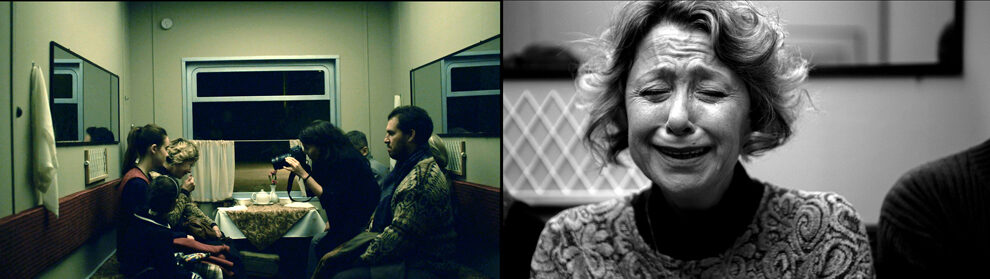
Finally, in the video installation The iron road (2021), Ira Eduardovna recalls, in a reconstruction of her own memories through a double screen, the journey she took with her family when they migrated from Uzbekistan in the 1990s. again the changing and transfigured landscape that he last saw when fleeing the former Soviet Union. Some elements remain identical: wood, sconces and windows in enduring cabins that slide along similar paths that cross the same landscapes. And yet, the possibility of incarnating the memory itself is unrealizable, since, like any fragment of memory, it becomes slippery, unrecoverable and, ultimately, inconsistent with its own truth.
Text: Luis Cemillán Casis


