This edition Casa Árabe will host two guest curatorships, the first present in the exhibition hall by Habibi Collective and the second for the auditorium by Contemporary Image Collective.
The Habibi Collective´s is an exhibition that brings us closer to the work of Bouchra Khalili representate by ADN galería through two videoart pieces that, as Róisín Tapponi explains,»use local archival material to re-imagine visual narratives of political revolts».
In other hand, on a auditorioum format, the curatorship To Preserve a Revolution by Ahmed Refaat from Contemporary Image Collective (Cairo) show us »the revolution in retrospect» through the works of the following artists: Sarah Ibrahim (egy), Salma Shamel (egy), Nada Hasan (egy), Maha Maamoun (egy) and Mohammad Shawky Hassan (egy)
HABIBI COLLECTIVE PRESENTS: BOUCHRA KHALILI
Curator: Róisín Tapponi (Habibi Collective)
Róisín Tapponi, founder of Habibi Collective and Shasha, presents two works by renowned Moroccan visual artist Bouchra Khalili.
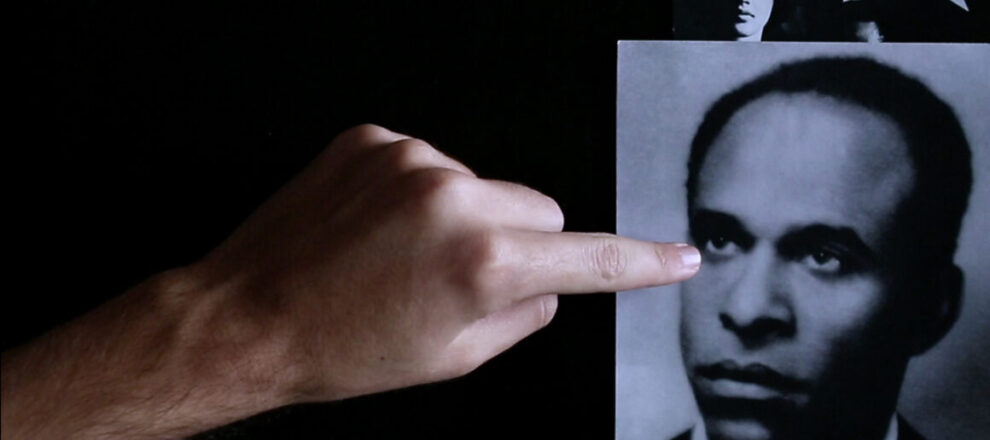
In Foreign Office (2015), Bouchra Khalili maps the political landscape in Algiers, the capital city of Algeria, from 1962-1972. This was a period when Algiers became the “capital of the revolutionaries” following Algeria’s independence from French colonialism in 1962. The city was an international mainstay for political liberation groups such as the Black Panther Party, the ANC (African National Congress) led by Nelson Mandela, the PAIGC (African Party for the Independence of Guinea and Cape Verde) led by Amilcar Cabral, and the Popular Front for the Liberation of Oman and the Arab Gulf.
This fragmented history is recounted by two young Algerians, who ask: why has this period been forgotten by a young generation of Algerians? Drawing on material culture such as oral histories, testimonies and archival images, the film attempts to map this alternative historiography of international liberation movements gathered together in Algiers.
In her latest film Back to Abnormal (2020), commissioned by the Wexner Centre for the Arts, Khalili meditates on the healthcare worker strike in Paris from March to May 2020. In the wake of COVID-19, the film is a document of the anger felt by many, due to poor conditions for healthcare workers, such as meagre pay and inadequate staff numbers for the surging cases.
The film interrogates the event through a historical lens: the social and political upheaval in Paris during 1968. This was immortalised by French New Wave filmmakers including Jean-Luc Godard, Chris Marker and Alain Resnais in their compilation of 41 documentary short films, Cinétracts. Khalili takes this film as inspiration, and mediates on the evolution of public sentiment and protest culture in Paris.
TO PRESERVE A REVOLUTION
To try and Preserve A Revolution is hard work. It’s an investigation in collective memory, an exercise in longing for something unattainable as well as an exploration of a medium’s limit. A limit cannot be seen, it’s by definition experienced in retrospect. In a way this is a program about a revolution in retrospect.
To Preserve A Revolution presents works by five Egyptian filmmakers and artists that both look at an event and the impossible ways of representing it. They address the experience of living through such an event as an active participant, a distant witness and a recollector.
The works in the program map affects through diaries, photographs, testimonies, TV archives, mobile phone footage and texts. The artists intervene with the image/audio sync, dismantling the power that documents of truths hold in their original form. By doing so, they reintroduce a context that goes way beyond informing a viewer. The works seek to reveal how memories are kept and how they can be re/membered through the moving image. It’s not a conclusion that they’re after, more like an open investigation for an ongoing historical process that tries to defy forgetfulness.