


Both the spectral and the real world come together through these four art pieces, which dialogue, speak to each other and answer each other, setting the limits of the physical and the imaginary into play; the visible and the invisible.
Concepts that collide, flow and overlap dance in front of us in a rediscovery of customs and rituals, but also of the family, cultural and geographical heritage of each artist – not as concepts that determine their origin, but rather their identity.
In this journey that is posed from intimacy and memory, these artworks also lead us to question the great universal questions through which cultures, thoughts, religions have been erected… and to which we continue to seek answers: What are we here for? Who are we? Where are we going?
The piece by the French-Canadian artist Alix Galdin is made up of two photographic series that dialogue around a reflection on the body and death. The images of “Reliquat” (2022) are questioning and answering each other. The emulsion veils echo and dance together. The images are accompanied by a poetic text that immerses us in personal and intimate memories.
The psycho-geographical journey of a city is consolidated through the work “I was a ghost yourself” (2022) by the Turkish artist Muge Yildiz following in the footsteps of a ghost, where the ancient is intertwined with the modern. As an archaeologist, the ghost portrays the present to uncover the past layer by layer through cracks and revelations, exposing himself with his memories and those of others who have come and gone before.
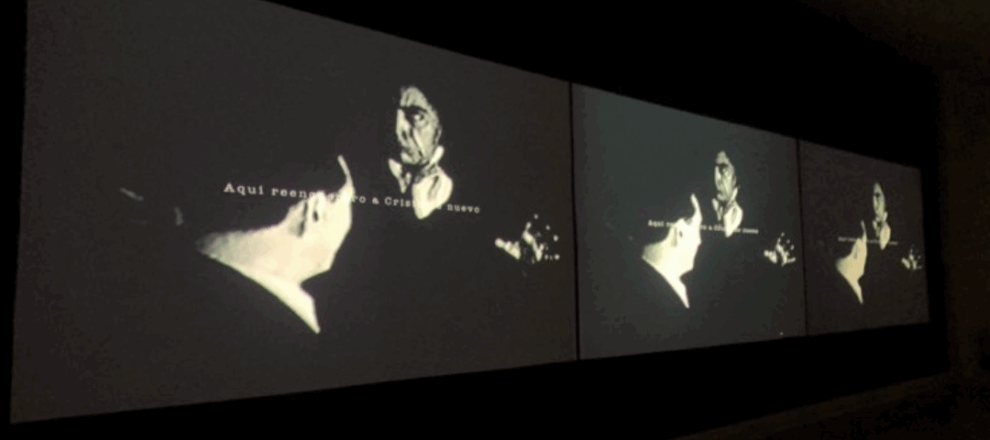
“María y los espíritus” (2022) is inviting us to a rite in the form of a phantasmagoria. The family archive works as a medium that seeks to stage characters that are embodied in light and movement; spectral beings that inhabit three-dimensional space, incorporating the viewer into a diffuse layer between documentary reality, fiction and performance. The work delves into family archives filmed by Fernando Aguirre Tupper, grandfather of Chilean filmmaker Nicolás Superby Aguirre.
We accompany the exhibition with the installation piece “Rage of the Caliban” (2006) by the American artist Wendy Wischer on loan from the collector Teresa Sapey. This work shows the moon watching its own come and go as it goes through its phases. A piece that found its inspiration in the quote from the preface of «The Picture of Dorian Gray» by Oscar Wilde, which I appropriate to end this reflection:
“The XIX century aversion to realism is Caliban’s rage at seeing his own face in a mirror.
The XIX century aversion to romanticism is Caliban’s rage at not seeing his own face in a mirror.»


