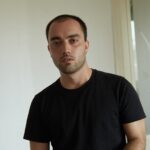
Two artists. Two peripheries. Two devices that do not fold. One maps the cracks of a neighbourhood that is falling (or rising) at the hands of what they call urban regeneration. The other makes a precise, almost surgical cut in the highway of progress. Sergio Cabrera Aparicio and Dídac Humà work from the margins, not only geographical, but also aesthetic and discursive, to highlight the invisible tensions that shape the contemporary city.
Mutaciones Urbanas observes, records and disrupts the narrative imposed on Vallecas, a historically working-class area that is now suffering from the frenzy of speculation. What was once a ‘neighbourhood’ is now an ‘investment opportunity’, and what was once a collective identity is now fodder for real estate rendering. Sergio Cabrera, with a critical but not melancholic gaze, proposes a visual reinterpretation of this changing landscape: an attempt to draw an alternative geography from the rubble, the dividing walls, the graffiti that still remains. His multi-channel installation does not illustrate the suburbs, it expands them. It gives them body, echo and presence beyond the suburban cliché.
Dídac Humà, for his part, makes expanded cinema with the precision of an anarchist urban planner. M30 is a literal and symbolic piece: a ring road converted into film form, into a physical sequence of 30 metres of 16mm celluloid. What circulates on it are no longer cars but symbols, layers, residues of the metropolitan flow. He moves the ‘M’ (for Madrid, Movement, Margin) to shift attention from the centre to the ring, from power to the edge. As if the film could make the official discourse skid, diverting traffic from the hegemonic narrative. The gesture, minimal in appearance, is deeply subversive: reappropriating the film medium, slowing down time, sabotaging linearity.
The choice of La Nave Imaginable as the venue is not a mere spatial coincidence, but a statement. Located in Carabanchel, just outside the M30, on that new frontier desired by developers and the displaced, the space embodies what its name suggests: the possibility of projecting, from the outskirts, new ways of imagining the centre. La Nave Imaginable does not impose itself, it infiltrates. And it welcomes these pieces as critical capsules that resist the homogenisation of the city.
Both works are tools — poetic and political — for reading the city from its scars. In contrast to the LED light festival in the centre, these artists propose other ways of narrating the concrete: from the grain, from the dust, from the skid. They seek neither redemption nor nostalgia. What they offer is a kind of urgent archaeology of the present, a critical reading of how capital paves over collective memories while selling ‘quality of life’ at 8,000 euros per square metre.
And if the periphery does not fit into the plan, there is always the montage.
Text: Mario Gutiérrez Cru