


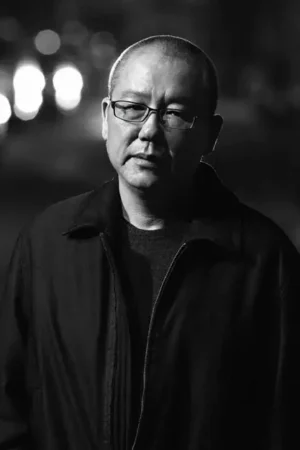
Chen Chieh-Jen
Artist
Chen Chieh-Jen
Artist

Taoyuan, Taiwan, 1960. Lives and works in Taipei.
Chen Chieh-jen is one of Taiwan’s most prominent artists working in contemporary video installation. Although video is his primary medium, his practice is shaped by collective processes involving local communities, workers, activists and temporary film crews. This collaborative approach gives his projects a social and political dimension, seeking to rethink notions of community, memory and history.
During Taiwan’s period of martial law (1949–1987), marked by the Cold War and anti-communist propaganda, Chen participated in underground exhibitions and guerrilla-style artistic actions that challenged dominant political structures. Following the end of martial law, he stopped producing art for eight years, a period during which he revisited his family history, childhood memories and Taiwan’s modern history. His artistic imagination was shaped by an environment marked by spaces of discipline, control and exclusion: military courts, munitions factories, industrial zones and informal settlements.
Chen’s work engages with Taiwan’s complex history, from Japanese colonisation to the structures of the Cold War, anti-communism and martial law, as well as the island’s integration into a global capitalist system based on the international division of labour. After 1987, Taiwan underwent another transformation under neoliberal policies, exposing new forms of precarity, exclusion and historical erasure.
In 1996, Chen returned to artistic practice, collaborating with local residents, unemployed workers, day labourers, migrant workers, unemployed young people, foreign spouses and social activists. Together, they formed temporary communities and filmmaking teams, occupied abandoned factories, entered restricted areas and constructed film sets using discarded materials. Through these practices, his works seek to make visible people’s histories, embodied memories and contemporary realities obscured by neoliberalism.
Chen describes part of his methodology through strategies such as “reimagining, re-narrating, rewriting and reconnecting”. His videos go beyond denouncing political and economic structures, creating spaces for mutual learning and experimental forms of community. Through poetic, dialectical and often silent imagery, his works open up a perceptual and political space where personal memories, experiences of dispossession, marginalised bodies and fragmented social histories intersect.
Since 2010, Chen has increasingly focused on the global precarisation of labour, the loss of a sense of existence and contemporary forms of control exercised by corporations and surveillance technologies. The artist refers to this condition as a form of “global imprisonment” or “at-home exile”. In response, his work explores the possibility of transforming desire, dismantling imposed illusions and opening up new forms of critical imagination.
His videos invite viewers to inhabit narrative gaps: silences, suspended moments, slowed movements and unexpected connections between historical events. Within these spaces of uncertainty, the image becomes a site for dialogue, memory and resistance.
Chen Chieh-jen has held solo exhibitions at institutions including the Vienna Secession, Art Sonje Center in Seoul, Mudam Luxembourg, Taipei Fine Arts Museum, REDCAT in Los Angeles, Museo Nacional Centro de Arte Reina Sofía in Madrid, Asia Society in New York and Galerie nationale du Jeu de Paume in Paris. He has also participated in numerous international biennials, including Venice, São Paulo, Lyon, Liverpool, Istanbul, Sydney, Taipei, Gwangju, Shanghai, Kochi-Muziris and the Asia Pacific Triennial. His works have been featured in programmes at institutions such as Tate Modern, Mori Art Museum, Centre Pompidou and dOCUMENTA 13.