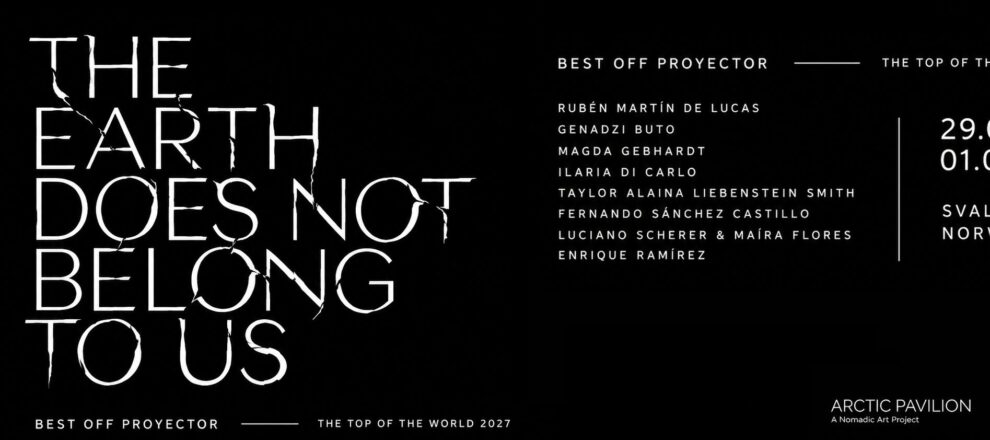
Curator: Mario Gutiérrez Cru
Festival Top of the World in Svalbard
Svalbard, Norway · January 29 – February 1, 2027
“Man does not govern the forces he has unleashed today; rather, the forces he has unleashed govern man.”
José Mujica.
The Earth was here long before us. Long before we began drawing borders, erecting monuments, building nations, or extracting from beneath its surface the materials that sustain our idea of progress.
Yet we have turned territory into property, landscape into representation, and nature into a resource. We have drawn imaginary lines across surfaces that are constantly shifting, determined who has the right to occupy a place, and learned to contemplate destruction as though it were just another image.
This BEST OFF PROYECTOR selection brings together eight works that question our relationship with territory: the construction and disappearance of landscapes, mechanisms of political control, migration, the memory of the disappeared, and the transformation of matter that preserves the traces of our presence.
The absurd borders that Rubén Martín de Lucas draws across the land, as ephemeral as the nations he imagines upon icebergs destined to disappear, remind us that these artificial divisions have very real consequences. On the shores of continents, the motionless bodies of Luciano Scherer and Maíra Flores evoke those who have lost their lives attempting to cross them. Water thus becomes a place of death, but also of memory.
Enrique Ramírez examines Chile’s political history, marked by dictatorship and the disappearance of citizens whose bodies were thrown into the sea. His journey through La Moneda Palace symbolically crosses a space of power and repression. This institutional violence finds an ironic counterpoint in Fernando Sánchez Castillo’s choreography of riot police trucks, where vehicles designed to control crowds perform a romantic dance.
Elsewhere, Magda Gebhardt constructs and destroys landscapes almost as if playing a children’s game, exposing the ease with which we transform what we contemplate. Genadzi Buto takes drawing beyond the confines of paper, extending it into the world and questioning the power of a simple line to alter our perception of reality. Two seemingly innocent gestures that remind us that every landscape is also a construction, a way of seeing and organising the world.
In Taylor Alaina Liebenstein Smith’s work, permafrost ceases to be a distant landscape and becomes matter transforming before our eyes. Its thaw reveals the fragility of what we once considered permanent, releasing a geological memory that has remained frozen for thousands of years. Meanwhile, Ilaria Di Carlo uncovers the violence of resource extraction beneath the appearance of the sublime, revealing a wounded territory whose devastation takes on an unsettling beauty.
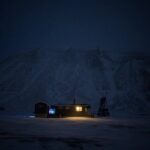
Presenting these works in Svalbard takes on a particular significance. In a territory shaped by ice, resource extraction, and the accelerating transformations of the Arctic, the images no longer refer solely to distant places. The landscape that hosts them is itself part of what they question. Chile’s political memory, the bodies of those who disappeared in the Mediterranean, imaginary borders, and the scars of industrial exploitation converge here, in a place where the very ground is changing beneath our feet.
Perhaps the Earth has never belonged to us. What does belong to us is the responsibility for the traces we leave upon it.
Mario Gutiérrez Cru